Showing posts with label propagation. Show all posts

Friday, March 26, 2010

A stick in the mud.

Last year, I cut back my butterfly bushes near the end of February. Because I'd been told before to just "stick that there where you want it to grow", I pushed the cuttings deep into the soil in the perennial bed. Those sticks rooted and turned into nice sized plants that were dug and given to Carla a couple months ago. Successfully rooting a few plants outdoors, in the native soil, I decided to give it a shot again this year. Over the past week, I've been sticking all sorts of things around the backyard. The soil is very moist this year thanks to all the winter rain.

Saucer Magnolia


Sweet Shrub


Forsythia


Mock Orange


Double pink althea


Spirea


Figs
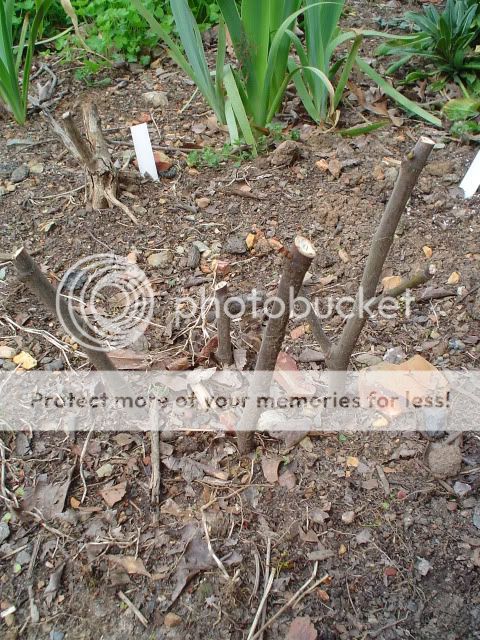


Weigela


Burning Bush


Plums


I don't expect all of these sticks to turn into plants. However, even after two sunny days in the mid 70s, all of the ones with leaves are still looking healthy and not wilting. Some are easier to root than others using more traditional methods. It's an experiment, like a lot of what I do. If it's successful, it means no transplanting later, nice colorful spring blooming shrubs all around the edge of the backyard, and nothing but a couple hours of time spent outside on warm days.

It's 59 degrees this morning. The high today should reach the mid 60s. We had a little rain last night. When the clouds roll out this afternoon, the temperature will drop. Tonight, we might have a chance of frost. The predicted low is 34. I'm keeping my fingers crossed that so much warm weather this past week has warmed the soil enough to keep the frost at bay.

12:47pm - It's 64 degrees. At the store, we've been busy as usual. I've put out nearly 20 carts of shrubs and flowers with others left that I won't get to today. It's kind of hectic.

Two customers came in this morning. The first had a clump of blooming twigs in her hand. She wanted to know what they were. She'd lived in her house for 5 years and had never seen these trees bloom. They are flowering crabapples. She lives on Montgomery Avenue. These are hers.


The next customer had a piece of a red camellia with yellow center. She wanted to know what it was. She had never seen it bloom before. I asked where she got them. She said from the woods off Brown Avenue. These are the blooms she brought in.


So I've met two "neighbors" in the past 4 hours. They all know my house and the yard. Both were full of compliments. It's good to put faces to houses.

On the front slope, the daffodils have filled in. In the years to come, there will be lots more.


The tulips have opened.


And the Morris Plum is blooming in the orchard.


I've got three more hours to work. It's starting to look like rain. Easter liles have arrived. The price dropped $2 this morning. Get them while you can. Boston ferns are $7 each. We've sold more than 400 in the past 2 days. I have 7 carts of 48 coming in the morning. We're out.

Thursday, February 11, 2010

Rooting Figs - Step Two.

The first step in my latest effort to root figs was completed on January 22 and February 2. I had cleaned, wrapped and stored 7 fig cuttings between those two days. The process is simple. Wash the cuttings with antibacterial dish soap, dip in a 10% bleach solution, allow the cuttings to air dry, then wrap with damp newspaper and store in a zip lock bag at room temperature. I kept mine in the basement where it's warmer and the temperature more consistent.

Four Marseilles VS cuttings were done on February 2 with the Black Missions receiving the same treatment on January 22. The Black Mission cuttings have suffered a bit over that time. Roots began to grow, and I'd do something stupid and break them off. I figured it was better to get to the next step before I sap their energy reserves completely.


First, I needed my supplies. The basic premise to rooting figs is simple. Maintain temperature and humidity, provide plenty of moisture and air to the root zone, and wait. I have a storage container, a wire rack built from hardware cloth, clear plastic cups with holes poked for drainage, and the rooting medium. I'm using an orchid mix. It's not what is suggested, but it meets the basic requirements. It holds moisture and allows plenty of air to circulate through the cups. It will also be easy to remove when I'm ready to transplant to a potting mix composed of 60% perlite and 40% peat.


The Black Mission cuttings have plenty of initials.


The Marseilles VS cuttings have a few as well. These are the white bumps on the ends of the cuttings.


This is what a preferred cutting looks like, plenty of nodes and a good 8-10" length.


The Marseilles are a bit shorter and have only two nodes each, but it's what I was given, so I will not complain. It just makes it a bit more challenging to root.


Each cutting is inserted into a plastic cup with the orchid mix. The cups are placed on a wire rack. The purpose of the rack is to keep the cuttings from contacting a cold surface such as a table top. This should help regulate temperature swings in the basement and reduce the chances of condensation which increases mold growth.


When it's finished, I used a white garbage bag to cover the top and placed the lid back on. This is a recycled container that was previously used to build my very first cloner which I haven't shown on the blog before. It worked, so I moved on to the current iteration.


Now, all I have to do is wait. It should take 4-6 weeks for enough roots to form to pot them up in the next step. I'll need to remove the lid once a day while doing my best not to disturb the roots. The cuttings still need air to survive. Once leaves are visible, they'll need light as well. I can handle that with a CFL spot light above this container. I don't have room on the plant rack for these. By the time they've rooted, the cotoneaster and other hardier cuttings will be in the hoophouse, I hope.

Speaking of the plant rack, I've got a bad case of spider mites and aphids. I trimmed the foliage from all the brug cuttings yesterday. It was destroyed in the wood stove. I treated everything with a spray made for spider mites from Spectracide. I'm hoping one more treatment will get rid of them for good.


It's 28 degrees outside, up from 23 overnight. We should reach the upper 40s today. Snow is in the forecast for Saturday morning and possibly Monday. Really. Haven't we had enough rain/sleet/snow this year? Come on!

11:42am - Third cup of coffee. All the usable firewood from the dead oak tree out back is now stacked in the basement. The last load was a good feeling.


Depending on the weather, this will probably last a week, maybe 10 days. At least it will be drier than if I left it in the gully where the water still flows freely through the stream.


It's an absolutely stunning day, if it weren't so cold.


It's 39 degrees.

Thursday, August 6, 2009

Growing my gardens

I've reached a point where I will snip something off a plant I don't even care for to see if I can root it. Usually I stick it in the cloner and forget about it. I've never tried rooting eucalyptus. I've never even had a eucalyptus before. I got one last week at the store. I even paid full price. It's not really hardy here, but I have a good spot for it next to a South facing brick wall.

Back to the cuttings...I took cuttings of passionvine, eucalyptus, three kinds of tomatoes, and a Mr. Lincoln that I broke off accidentally. I was trying to dig a hole, but more on that in a minute.

Small cups will be used this time. I'm trying the baggie method too. That's new for me, but one thing I run into using my containers is critter feasts. Before the cuttings can root, pillbugs begin chewing on the cut end. Then comes fungus, and finally rot. So, this should eliminate some of those problems.

All my tools. Rooting hormone is in the small dish. I use Rootone powder because it's accessible and cheap.


The passionvine cutting with all the leaves. I took one about 18" from the tip end. The cutting is about 6" once the top foot is removed. It's too young to root. I want three leaf nodes with mature leaves.


I stripped the bottom two sets of leaves. These will both be sunk into the soil. If the bottom on fails to root, or rots, the middle node might root in time to save the cutting.


I dusted it with hormone, stuck it in well draining soil, and placed it in a gallon sized zip lock bag with the two eucalyptus cuttings. What am I going to do with three eucalyptus plants?


After I stuck the tomatoes (yes, I know what the date is, trust me), I put all the bags at the end of the driveway. The sunlight here is dappled only late in the day. It never receives any direct sunlight. I want to keep them where I can watch.


A cutting from kongmansia. The mother plant is stressed thanks to a spider mite infestation and the treatment. I hate using chemicals. I put this one in the cloner. I hope it roots, but I expect it to turn to mush.


I mowed the yard, weeded in the perennial bed, edged the driveway, took lots of photos for my records, hauled a little stone I found near the edge of the gully, and finished the back bed's border.


Yes, it is a knockout rose, a single red. I like the combination with the Mystic Spires salvia. Next year, the lavender, salvia, and roses should fill in nicely. The climbing hydrangea behind it is growing. Well I know what'll be covering the rotting trunk of that oak tree in the back yard in a few years.


There's more I want to do, but as it is, I'll sleep well tonight. I'm just going to take that one cutting, first.

Propagation results.

On June 14, I stuck gardenia and rose cuttings from Jim @ The Gaudy Garden. Unfortunately, I lost all 6 of the rose cuttings to fungus. I also lost a couple of the gardenias, which is surprising since they normally root incredibly easy. These are the old gardenias. The mother plant was over 6' tall and wide. Shortly after, I also stuck cuttings of eleangus and several other plants including my snowball viburnum.

This is what they looked like this morning. I've been ignoring them. As Nell says, labeling them ensures failure.


Pyracantha - I lost several, but two rooted.


A gardenia cutting.


Snowball viburnum - all three rooted.


I potted them into gallon sized pots using a fast draining cow manure compost. Broken bags, half price.


On July 2, I potted up the hydrangeas that I rooted in my homemade cloning machine. They're ready to be potted up again and should be planted out in early September. I'll move them to 1 gallon nursery pots this afternoon. They'll get the same cow manure compost as the others. It'll give me nice growth, without the likelihood of burning the tender roots using chemical fertilizers.


Here's the variegated hydrangea I rooted without really trying. I wish all plants were this easy.


And a variegated sedum I got from a customer at the store. I took another clump of her sedum in exchange for some low growing bamboo.


Then I spent an hour cutting up more of the fallen oak tree. Most of the branches you see are more than 16" in diameter. My dad will be coming up in a few weeks with a larger chainsaw. He's considering bringing the small tractor to pull the limbs out of the woods and into the yard. If he does, I'll get him to till the gully area where I want to plant a garden next year.


I promised Cat I would show her how to take cuttings of passionvine. I haven't forgotten. I've got a list of things I plan to make more of. I'll do that this afternoon. There will be pictures.

Thursday, July 2, 2009

Propagation - softwood, hardwood, and seeds

Hardwood cuttings are taken in the winter from deciduous plants. This past February, I stuck cuttings of figs, mock orange, forsythia, and a few others. The mock orange was decimated by tent caterpillars after it rooted and has died. The forsythia and figs need to be potted soon. I might do that today before I go to work.

The method is simple. Take cuttings from dormant plants, dust the bottom end with rooting hormone, stick in a well draining soil (1/2 sand, 1/2 Lowe's cheap topsoil), and wait.


Softwood cuttings can be done in April and June here in NC. These were stuck 3 weeks ago. All of the hydrangea cuttings rooted. Only a few of the others have rooted, including a beefsteak sucker. They were potted this morning. I'll keep them in the basement under my lights for another couple of weeks. It's too hot and dry to put them outside just yet. I need more roots.

I used the cloner for these, although you can use the baggie method or container method I've used to root gardenias and roses.


The easiest way to propagate many plants is through seed collection. Wintersowing the seeds is simple. There's a link on the sidebar.

Melampodium seed. I didn't collect these, just tossed them back into the garden where I want more. This works best in areas with no mulch.


Forget Me Nots. Again, tossed back into the garden. In another week or so, I'll pull the plants out and shake them along the edges of the beds.


Salvia subrotunda. I will be collecting these seeds. This salvia is over 5' tall and has shown no problems with wilt, unlike the salvia splendens (Yvonne's salvia, which I will also collect later).


Coreopsis "Mahogany Midget". Seeds collected last week are laying in a coffee filter to dry. This time of year, I have seeds all over the house.


Other seeds I'm waiting for are being noted below.

Rudbeckia. Seeds were collected from Autumn Colors and wintersown this January.


Monarda didyma.


Blue agastache.


Monarda didyma.


Yvonne's salvia. Over 4' tall and still growing.


Zinnias


Esther's sunflower.


Monarda citriodora 'Lambada'


Coreopsis "Full Moon"


It goes without saying there are others I'm waiting for, like datura inoxia.

12:01pm - the figs and forsythia are potted. The figs had only a few roots, but hopefully enough to make it on their own. The soil was bone dry and yet they were still alive. The forsythia had lots of roots. I expect them to make it. I'll plant the forsythia in the new shrub border this fall. The figs may or may not be planted. If they aren't, they'll be traded for other rooted cuttings this winter.