Showing posts with label elaeagnus. Show all posts

Sunday, March 14, 2010

Sunday, Sunday, Sunday!

And I'm off from work. I have to go meet my sister again today, but this morning, I'll be in the yard in half an hour. I've got some plants to move, rooted cuttings to plant, and I want to do some general cleanup.

In the 10 day forecast, there's still no freezing temperatures. I'm not about to believe that our last freezing day will be March 9. It's a really nice thought, but I know better.

It's currently 45 degrees and clear. Last night it rained, and then rained some more. The clocks need to all be set forward an hour. Welcome to Daylight Savings Time. It'll be nice to have the extra hour in the evenings.

10:54am - I've gotten a few things done.

I stuck some cuttings. Left to right, top to bottom: unknown spirea, unknown spirea, yellow knockout, burning bush, burning bush, row 2; unknown spirea, unknown spirea, yellow knockout, white spirea, burning bush. The lower tray: top row, Carla's current fig, possibly a Celeste or Brown Turkey. Bottom row: black missions from Carla's former house. I don't label when I do things like this because they're more likely to die. I've put them on the seed rack by the woodpile on the shady side. The leftover fig cuttings were stuck here and there in the yard.


I planted out eight quarts of wintersown dianthus "Depford Pink". They're along the top of the wall below the lavender and knockout roses.


Blue Spruce sedum was divided and planted along the top of the wall below the butterfly garden. That's where I have the 200 daffodils.


To delineate the end of the butterfly garden, I moved the three clearance cotoneaster plants from the upper meadow to the front slope. Beyond this, I'll let the vinca, violets, and whatever else run wild. Maybe.


A few feet from the edge of the "lawn" at the top of the same slope, parallel to the street, I planted six rooted gardenias. I also moved an Endless Summer Hydrangea to the very end of the line.


Forty-eight wintersown Rudbeckia hirta were planted in various spots in the yard. They're still tiny, but I know lots of the plants will survive. Mother Nature will cull the weak ones. I may have to intervene at some point.


Eight calla lilies, purchased for 25 cents a piece went into the perennial bed near the ever blooming camellia. It's drier here in the winter than elsewhere, so they might return. I had them in a yard in Charlotte on Country Club Drive when I rented a house there.


I also pruned the neighbor's rose bush, planted out a couple of Arizona Cypress "Carolina Sapphire". These trees reach 30-40' tall and 20' wide. They have a bluish color and grow almost as fast as Leyland Cypress. They were developed by Clemson University for use on the East Coast. In front of these, I moved two rooted cuttings of Elaeagnus. They're really well rooted, so I expect them to thrive in the full sun. I've sort of left a path to the stream back there. I know in the next few years, things will grow in and block it. I'm okay with that.

I moved some sedum from last year's clearance sale to the front slope, now known as the Butterfly garden. In the next couple of weeks, I'll be rooting more of it and the Blue Spruce. The dry soil should work well. I've got a few overwintered cuttings of a taller sedum that I need to plant today. I don't know. Somewhere. Why?

It's 52 degrees. I've got a few more things to do and about an hour and a half to get them all done. I have to be in Cheraw at 3pm. The third cup of coffee is cooling off.

12:12pm - I'm going to stop for the day. I planted some rosemary in the bed at the end of the driveway on the sunny side.


Along the bottom of the retaining wall next to the driveway, I divided and planted Coreopsis Full Moon. I moved these from the perennial bed. I pulled back the leaves and cut back the dead foliage from Coreopsis "Moonbeam". There are Stella D'Oro daylilies and orange ditch lilies in this bed all along the wall. I planted out 12 more wintersown Rudbeckia containers here too. Let's see if all this yellow and orange clashes with the blues and pinks above them in the front beds this summer.


Five butterfly bushes were transplanted to the butterfly garden. I placed them at the top of the slope. Between them, I planted 6 overwintered clumps of tall sedum. Milkweed, lantana, and other butterfly plants will be scattered through this bed.


I've got a follower in the yard. This robin went everywhere I did, plucking earthworms from the dirt I was disturbing. It came within 6 feet of me several times.


On the agenda for my next day off, the front bed. The pansies will be done in a couple more months. Heucheras are putting out new foliage and the Japanese Maple will be leafing out soon. I've already installed penny priced nandinas, rooted gardenias, and tea olives. For summer color, I'm going to plant echinacea and shasta daisies to brighten up this bed. It gets a little sun in the mornings and evenings, so these two should do okay. I may root some more Montauk Daisies for late summer blooms.


It's 54 degrees and sunny. I need lunch and a shower.

Thursday, March 11, 2010

Editing.

First, there's a poll on the sidebar. I'd like to know how many people are reading my blog. It's just a curiosity thing, certainly not scientific at all.
_____________________

On the north side of the house, I planted 18 Carolina Cherry Laurel seedlings last fall. Surprisingly, in little sun and frozen ground, they've all survived, I think. I spaced them 18" apart, knowing that was too close at the time. I'll need to remove every other one soon and replant them elsewhere in the yard. As an evergreen, they'll work nicely around the borders of the backyard eventually reaching the height of small trees if I let them. Instead, I'll pinch and snip and force them to branch out into shorter, stockier plants.


A few feet away, I planted cuttings that were rooted from Carrie's Elaeagnus. They're in the Neighbor's corner. The plants I took cuttings from were easily 12' tall and possibly just as wide. They were huge. They're too large for the space I have them in for sure. They'll also be moved to the edges of the backyard, possibly in front of the dead oak tree as suggested by Tim from Atlanta.


The silvery foliage should play nicely with the vitex I recently installed. That particular plant has now been moved to three different locations since I purchased it last spring. It now has a full sun site and should bloom profusely for years.


Also in the Corner, I have another Leyland Cypress that will find a home around the edges of the backyard. It was originally installed in an attempt to block the view of a bomb shelter and garage that belongs to my peering neighbor, Cat. She was best friends with the woman that gardened here for 40 years. She's got mixed feelings over what I've done to the yard so far.


There's a pyracantha near the upper meadow that needs a new home too.


I've already moved two of these from shady spots along the top edge of the gully. I will probably transplant it soon into the same area near the dead oak tree.


Several rooted gardenias need a new home. I'm currently thinking about the hill along the street between the ancient oak tree and the dying red dogwood. I think a hedge of gardenia would be a nice way to block some street noise while providing for a more private front yard. It's a shady area in summer, with very little direct sun.

Two pampas grasses need to find a permanent home somewhere in the yard. One is currently behind the swing, just in front of the dead oak tree. I'm not crazy about these grasses, but I do love the plumes. Both have been moved multiple times and have never put down enough roots to make transplanting a problem. I was worried they wouldn't survive, but sure enough, there's new growth on both. As they grow very large and continue to spread, I need to give them a lot of room.


Along the end of the driveway, there are three cuttings of Snowball viburnum that survived the winter. I'll have to find new homes for them.


I've already moved the one that was along the edge of the gully, the parent plant for these three cuttings. Again, lots of space will be needed for these large shrubs.


I keep finding myself drawn to shrubs and plants that mature into large specimens. I blame the towering trees in the backyard. Trying to place a miniature shrub into a space that's currently framed by 100' tall oaks is not the easiest thing to do. Many plants will be overwhelmed by the scale of these trees. And yet, I still need space to plant the flowers I'm growing from seed.

One image I keep returning to for inspiration can be found on a blog header from my sidebar. I'm not unrealistic. I know that it will take years to achieve the look I want in my backyard. It's a waiting game. Nature does not hurry, yet everything is accomplished.

It's 45 degrees. Rain will be coming again this afternoon, sometimes heavy. On Sunday morning, I'll start moving the plants I listed above.

Wednesday, November 25, 2009

I miss my shadow

It's another dreary, cloudy day here in NC. Overnight, it rained again. It wasn't much, but the ground that was soggy is now fully wet. Walking across the lawn leaves depressions. On the other hand, we're less than a month away from reversing the tilt into winter. Solstice will be here before we know it. The last of the fall color in the backyard is gone. The only remnants are the leaves covering everything that stands still.


Not everything is so bleak. Morning glories in the wild are still blooming. This one has entangled itself with the elaeagnus.


The orange rose is still blooming too.


These buds probably won't open with frost in the forecast for Friday night.


Up the street, Calycanthus floridus is still green and golden. I have several of these planted in the shrub island that I wintersowed last year. The largest one is about a foot tall.


Sweet gums are still dark red. I should try to locate some seed pods for the gully when I go home tomorrow for Thanksgiving. They grow all over the place at my parents' house.


Speaking of the parents', my mom wants two Leyland Cypresses for her yard. I planted these along the fence earlier in the spring. They need to be moved, so I'm taking them to her. Tomorrow is also her birthday. I bet she thinks I forgot.


Miss Huff (probably not) is lonely without Yvonne's salvia. With so many unripened seeds on the Salvia, I cut it down this morning and brought the flowers into the basement to dry. I won't trade seeds from this batch, in case they aren't viable.


Cold weather is on the way. I need to find a day to get out back and collect more firewood. There's plenty to be had. I just need to split it with the gas powered log splitter. Waiting for a cold day. Things that slither could still be moving under all that greenery.


For all of 5 seconds, the sun tried to peek through the heavy clouds. Then it disappeared. If the forecast is right, we should see some sunlight before it sets tonight.

Saturday, October 24, 2009

Growing Oranges in North Carolina

It's called Japanese Bitter Orange, Poncirus trifoliata. It's a thorny, sparsely leafed shrub that reaches 10-12' in height. I found it last winter in the "wild" beyond the edge of the backyard. There's another in the gully. In spring, they bloom with a light sweet citrus fragrance. The leaves are insignificant. I imaging these two shrubs have survived for years with no care, no pruning, and no fertilizer. Until the oak tree fell, the one pictured here lived in deep shade receiving only winter/early spring sunlight.


They do produce oranges. They have a very bitter flavor, and leave their scent on your hands much longer than you'd like. The skin is slightly fuzzy, like a peach. The largest one this year is about the size of a ping pong ball.


Inside, there's very little pulp, lots of juice, and a dozen or so seeds.


Since the seeds do not store well once removed from the fruit, I have already sown several in outdoor containers. I plan to use these and pyracantha to create a bird habitat in the gully. The thorns will protect them while they eat berries and sample the fruits from these spiny shrubs.


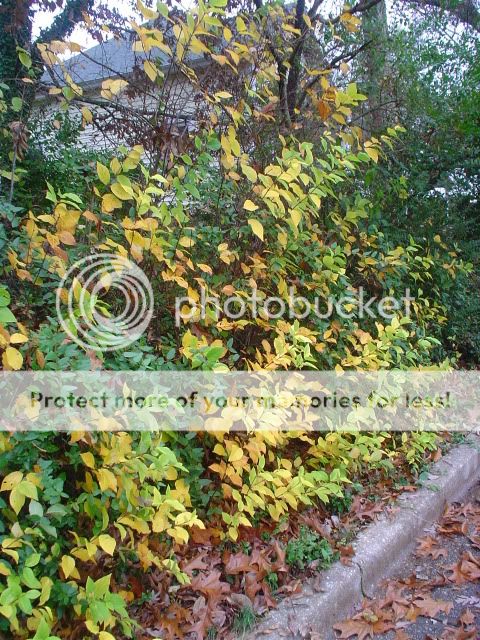
Planted nearby, and intertwined with the hardy orange, is an elaeagnus. I'm not sure of the variety. Again, grown in heavy shade, I've never seen any fruit and have only found this one specimen in the woods. I suspect it's E. pungens. Some varieties are highly invasive. Given no others are nearby, this is probably not the invasive Russian olive, E. augustifolia. There are several common names, silverberry, Autumn Olive, Winterthorn. This one has small, golden flowers that aren't as highly scented as I've read about. I plan to propagate more of this shrub in the spring using softwood cuttings.


New growth from maturing stems appears as 1" long spikes. These later develop leaves and become new branches. Given ample sunlight, they really put out some amazing growth in just a few weeks.


In the shrub island, the "white" hibiscus is blooming again. I guess I should give this one a name as well. Grown from seed, the flowers are a deep, dark wine color. The picture is lighter than the actual color. This one shall be called the other, other red hibiscus.


More of the wild.


At the edge of my property along the perennial bed, the maple has really taken on some color in the past 24 hours.


Across the street, Beth's back yard is something I aspire to. I'll be raking leaves back here in a few weeks to use as mulch and add to my compost pile.


It's 70 degrees and cloudy. We got rain for all of 3 minutes last night about 1am. Several passing drizzles have dampened the soil this morning. More scattered drizzles expected throughout the day. We need a lot more rain, not this teasing habit Mother Nature has developed.